Showing posts with label valencia. Show all posts
Showing posts with label valencia. Show all posts
Valencia, unforgettable holidays
Valencia is one of the largest cities in Spain, and also one of the most visited places in the country. It lies on the coast of the Mediterranean Sea, so it has many beaches close to the city centre.

Its cultural offer is almost endless, with its Cathedral, el Miguelete or the Lladro museum. But what is probably most impressive is The City of Arts and Sciences (La Ciudad de las Artes y las Ciencias), an architectural and cultural complex destined to the entertainment. This complex is formed by eight buildings.
These buildings are: L’Hemisfèric, a planetarium, laserium and an IMAX cinema; el Museu de les Ciències Príncipe Felipe, an interactive museum of science; l’Umbracle, which contains alien plant species; l’Oceanogràfic, an oceanographic park; el Palau de les Arts Reina Sofia, a performing arts centre and an opera house; el Pont de l’Assut de l’Or, an impressive bridge; l’Àgora, a covered square; and finally the Torres de València, which is still only a project of three skyscrapers.

For those who are very keen on gastronomy, in Valencia they will find one of the most famous and appreciated dishes in Spain: paella. This is a rice dish with vegetables and meat, offered in most Valencian restaurants, if you travel there, you can’t forget to try it!

One of the most famous festivals in Valencia is celebrated in March, and it is called the Falles. During this festival, each neighbourhood builds a kind of construction which is known as falla and in the end it is burned.

For those interested in going to parties, there are many music festivals during the whole year, especially in the summer. Besides, there are also a huge number of discos for all tastes.
So, if you travel to Valencia, make the most of this experience, eat in the best restaurants and get immersed its interesting culture and atmosphere.

Continue reading a new post on Spain Holidays 10: Things to do on holiday in Mallorca
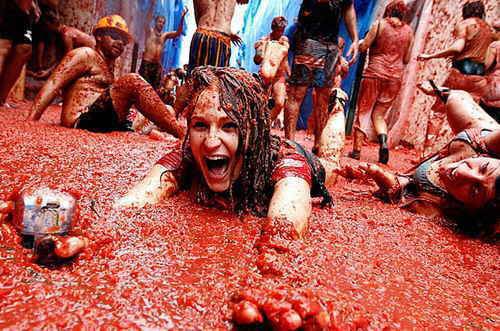
La Tomatina - The Worlds Biggest Tomato Fight
How does
the world's biggest tomato fight start? Who owns the claim to fame as to having
the world's biggest tomato fight? Nobody seems to be crystal clear as to how
this gigantic tomato fight got started. But it did, that's for sure. It would
seem that people hold within themselves the need to throw food and have a great
deal of fun doing it. Seems to me that to be involved in a huge, crazy tomato
fight, just might be a real blast! If nobody gets seriously injured in it, then
maybe it just fulfills a nature desire that's in all of us.

This food
fight is believed to have been started in either 1944 or 1945. It is said that
they had so much fun throwing tomatoes that it has continued every year since
then. Twice the government tried to stop it out of concern for safety issues.
It was finally given the big go ahead in 1957.
What does
it take to put on a food fight of this proportion? Lots of tomatoes of course.
Were talking in the neighborhood of 240,00 tomatoes or the equivalent of 140
tons. Rest assured that these aren't perfectly good tomatoes, that could be
used for food. Didn't you always wonder about that? No, these are damaged or
spoiled tomatoes. They are trucked in from another small town called
Extremadura, because they can supply a large amount of damaged tomatoes.
Extremadura has quite a large growing area of tomatoes and also manufactures
lots of tomato paste.
Celebrations
start a week in advance of the La Tomatina with festivals of food, bands and
fireworks. The size of the town's swells to about 20,000-40,000 people at the
time of the celebrations. There's food and drink flowing.

The day of
the tomato fight starts early with the flow of wine in abundance. The tradition
is for the festival to always be held the last Wednesday of August from
10AM-1PM. The towns people bring out large sheets of plastic to cover there
wares and buildings from flying tomatoes. People are dressed in clothes that
they expect to throw away after the food fight. There are some rules to be
followed. No sharp objects are allowed and of course no glass, such as bottles.
The tearing of other people's clothes is also not allowed, but of course this
happens quite often. And tomatoes are only supposed to be thrown after they
have been smashed.
The morning
of the festival a large pole is greased and a ham is put up at the top. The
commencement of tomato throwing is suppose to start when someone climbs the
greased pole and makes it up to the top. But most years the throwing begins
before any body can get to the top. The crazy throwing of tomatoes lasts for
about one hour's time. Then many people take off for the Bunol River near by to
wash up.
Once the
festival is over, the shop keepers take down all the tomato covered plastic,
and clean up begins. They use fire trucks to hose down the streets with water
brought from Roman aqueducts. And that's the story of the worlds biggest tomato
fight.
Continue reading in Spain Holidays 10: Summer travel to Spain on a Budget
Valencia offers history and innovation

Valencia is a mix of very old legacy with avant-garde architecture and the most innovative buildings. The most ancient remains found there date back to the year 138 B.C., its name comes from the Romans, they had already called Valentia.
It is a city that has evolved over time, it has always had an interesting location for all settled cultures in the Iberian peninsula, only have to visit the cathedral in order to understand this since is built over an Arab mosque, which was in turn built on a Roman temple. This great cultural mix is located in the Plaza de la Virgen, where we can also visit the Basilica of the Virgen de los Desamparados and not very far from there is the Royal Convent of Santo Domingo, a building that dates back to the XIII century.
To this collection of antiques we must add the Palau de la Generalitat and the Lonja de la Seda, both built in the gothic style and were declared Patrimony of the Humanity.
All of this coexists along with buildings as emblematic and contemporaries such as those that make up the City of Arts and Sciences of architect Santiago Calatrava, formed by a Planetarium, the Arts Palace, the Museum of Science and the Oceanographic Park.

If we talk about culture, is a very active city due to the large number of fairs and congresses that offers its formal agenda at the European level, is considered a cultural, commercial and business center very important.
Another factor that makes Valencia a nice place to visit are its Mediterranean climate and its shores, the Valencian coast have very extensive tourist beaches, where you'll find places to cool off and taste its gastronomy, like a paella, right in front of the beach with the sand at your feet and next to the sea.
For those who don't like the crowds in summer, there are also other more sheltered and private beaches.

Between the beaches we find the Natural Park of L'Albufera, a place where you can also enjoy the sun of the Valencian coast with an incredible vegetation. The most popular destination is the Malvarrosa beach and its promenade, full of leisure options and a perfect place to soak up the sun by day and go out and party at night.
Finally, the great feast that characterizes Valencia, Las Fallas. These have a long tradition and attracts many tourists each year.

Subscribe to:
Posts
(
Atom
)


